Sunday, September 2, 2007

Thank You, Mother Teresa. You've shown me a new way to frame atheism.


“The priests used to say that faith can move mountains, and nobody believed them. Today the scientists say that they can level mountains, and nobody doubts them.”
— Joseph Campbell

I've been following the articles about the publication of the letters where Mother Teresa revealed her personal crisis of faith. While reading Christopher Hitchens "Teresa, Bright and Dark" (also on Richard Dawkin's site) it finally hit me, the difference that really matters between atheists like me and theists of Mother Teresa's type is how we deal with doubt, ignorance and uncertainty. We atheists really have been framing a lot of our arguments badly.

I think I can show you all a better way to frame this debate. You decide.

The Barefoot Bum writes that the "supposed coexistence of faith and doubt—in either sense of the word—is a transparent sham." And that's pretty close to my own views. However, doubt and faith do co-exist in all of us, but not both doubt and faith in the same assertion. There are only three options for any single assertion you're asked to believe: 1) "I trust it," 2) "I don't know," or 3) "I doubt it." You can't claim to mix two opposite ends of that spectrum, doubt and faith, and make sense unless you're talking about trusting some claims and assertions while doubting others. For example, Andrew Sullivan who makes a big deal about his mix of doubt and faith has faith in claims about some happy after-life but doubts biblical passages saying homosexuality is an abomination to God.

I'm bringing up this rather obvious point because I think a lot of us atheists are focusing on the wrong assertions. It's not about whether something like a God exists or doesn't exist so much as whether you can make any claims about knowing anything about God. For example, consider how much there is to agree with in the works of non-atheists like Thomas Paine and Voltaire in their criticism of religion. Much of what they had to say about religion is still relevant today and is still rejected by most religious people.

For another example, there's an old article in the New York Times, "Our Lives, Controlled From Some Guy’s Couch," about Nick Bostrom's idea that it is almost a mathematical certainty that we are living in someone else’s computer simulation. Maybe our universe is a simulation and if so, wouldn't the programmer(s) be our god(s)? If such gods exist they are so unknowable that there are few rational beliefs I can have about them/him/her/it. The only thing that would make the programmer gods of Nick Bostrom's future supercomputers more knowable than the gods of traditional religion is the concept that the simulation we are in is an ancestor simulation. It would mean our gods were once like us. They would have evolved in a godless universe too.

You don't find atheists complaining about Nick Bostrom's speculations because Nick isn't claiming to have talked to the programmers and come back to tell us how to live our lives and to have "faith" in the programmers. I don't know what to do with Nick's idea. I just go on living as I have before. Nick doesn't ask me to do anything much with the idea.

And what is religion? In some ways a religion can be defined as a collection of assertions that comprise a world view. Each different religion and sub-sect has a mix of different assertions. Some theists like to say atheism is a religion and the usual response to that is to say something like "if atheism is a religion then bald is a hair color," or, "... then off is a TV channel," or "... then sanity is another mental disorder." Well, we are turning off all assertions made about gods and there isn't necessarily any other assertions made to replace them, but most of us do have a naturalistic world view.

The problem with taking down the whole collection of religious assertions, made by every religious variant, in one debate is that it is like trying to nail jello to a tree. The theist can avoid stating his most doubtful assertions, like Al Sharpton did when debating Christopher Hitchens, and focus on the things you can't know either, like whether there is a god.

What Mother Teresa has shown us is what would be a good focus for future books and debates. We can skip over all those complicated arguments about God and religion and get to the real issue, which is how do you deal with doubt, ignorance and uncertainty? Mother T. has shown us this by showing us how badly some theists deal with doubt. She suffered not because she doubted, but because she didn't know how to effectively doubt.

I think Hitch might have missed something important in his article, and in his Hardball debate with Bill Donohue. Hitchens seemed to think that when Mother Teresa wrote in her letters things like; "Jesus has a very special love for you. As for me, the silence and the emptiness is so great that I look and do not see, listen and do not hear," that she was talking about doubting God's existence. But that doesn't make sense. How can you doubt God before you doubt the church? She retained her faith in her spiritual directors and confessors while she doubted God? That would be like me rejecting Nick Bostrom's speculations about our universe being a simulation yet still believing him when he tells me what the programmer wants me to do. I have to doubt the claims made about the programmer before I can doubt there is a programmer.

The same thing would apply for a flock of Christians who certainly believe in God but who might then be confronted by a preacher who tells them, "God wants you all to drink this cyanide laced kool-aid," as they probably wouldn't believe that preacher even though they believe in God. Oh, wait... I forgot Jonestown. Alright, how about a preacher who tells them God wants his followers to fly airplanes into skyscrapers... Oh, wait... Well, we hopefully can assume most religious people will not just follow anything someone who claims to speak for God says. Those are the ones we might reach with this different frame because they at least can doubt someone who merely claims to speak for God. It's impossible not to doubt many of the contradictory and absurd religious claims we encounter in our society, even believers doubt most of them.

I'm sure most Christians don't believe that everyone who thinks they’re hearing God’s voice really is. After all, most of us don't believe that because a schizophrenic is claiming that they can feel the microwave beams the CIA is sending into their brains that this is evidence that the CIA is doing such a thing.

The point is that if Mother Teresa really doubted God's existence she would have necessarily started by doubting those people who were telling her about God. You can't get to atheism while still believing in people who send you to an exorcist. You might trust them to be honest about their own beliefs and experiences, but you can't think they got the interpretation right, you can't believe that they know anything about a God you don't believe in. You might experimentally try things like prayer and exorcism, but not the same people over and over when nothing is working. The great tragedy of Mother T. is that if she really doubted she might have sought help from a psychologist and found out she was clinically depressed and then have gotten real help.

The Time magazine article I read had said that only a couple of the letters can be interpreted as expressing doubt about God's existence. They really seem to be indicating a hunger for some experience within her. The letters are also being published as part of the investigation into Mother Teresa's suitability for sainthood and I don't think Catholics would ever begin to make a saint of a real atheist or skeptic.

Mother Teresa is more unlike us, Hitchens and me at least, in her doubts than she is like us. Did she ever come to doubt her past experiences? Mother Teresa supposedly had a period of time where she literally heard God’s voice directing her to go to in India and help the poor. As soon as she did start her mission, God's silence began. In spite of the lack of instruction and encouragement from God, she continued her work.

Feeling the abandonment by God is not the same as doubting God. Mother T. knew something of what she was missing. I don't think she doubted her interpretation of her own past experiences. You can't doubt the meaning of your own past experiences without doubting the meaning of the experiences of others. The doubt of other's experience necessarily precedes doubting your own experience. It necessarily begins by seeing yourself in others. Quite a few Christians will claim confidence in their own experiences of God while doubting others merely because they haven't seen themselves in those others, but Mother Teresa did not doubt her confessors, she was just feeling a lack of something she expected. Mother T. did not really doubt and if she called her experience doubt, then she didn't really know what doubt was.

"I gave my love to Jesus, but now he never calls."
-Betty Bowers


Continued in PART 2

Wednesday, July 18, 2007

Informed bigotry versus Ignorant tolerance


Over at "The Reality-Based Community" Mark Kleiman has a post called "Atheistic bigotry" that takes PZ Myers to task for his casual, flippant comment about the "ignorant, deluded, wicked, foolish, or oppressed" who surround him. That comment showed up here. To which Kleiman replies:

... if I heard Jerry Falwell claim that all Muslims, without distinction, are "ignorant, deluded, wicked, foolish, or oppressed," or heard Osama bin Laden make the same claim about Christians, I'd just nod my head and say, "Yep. Bigots." So I might easily have made the mistake of calling P.Z. Meyers a bigot for saying exactly that about religious believers in general. And that would have hurt his sensitive feelings.

No, it won't hurt PZ's sensitive feelings. If PZ's feelings could be hurt that easily, then PZ would be as easily manipulated as Mark Kleiman into distorted, PC forms of ignorant tolerance.

While I agree with Kleiman that PZ's statement edges itself into being "bigoted," it's a more informed bigotry than Kleiman's tolerance is. If a bigot is just someone who is obstinately devoted to his own opinions, or one who is narrowly or intolerantly devoted to his opinions and prejudices, then the word "bigot" is just a general term that applies to everyone, including Kleiman.

PZ's bigotry is informed because PZ's blog has been documenting the great amounts of ignorance, delusion, wickedness, foolishness and oppression he finds in the news. For example, in just the past few days PZ has posted these items on his blog:

Another liar for Jesus
The great parasite and liar in the sky
Open season on gay men, apparently
Prayer for dummies

Of course, PZ is cherry picking his evidence, just like most of us in the blogosphere, and even PZ's own daughter rebuked us all for getting into this stupid fight. However, we've got more than PZ's cherry picked evidence to go on, we've also got extensive cross-national attitude studies, Gallup Poll data and more. Large groups and majorities believe in a personal God, an afterlife, Bible stories, the Devil, Hell, Heaven and miracles. There is a very low level of scientific literacy about human evolution in America when compared to other developed nations.

So, when Mark Kleiman says:

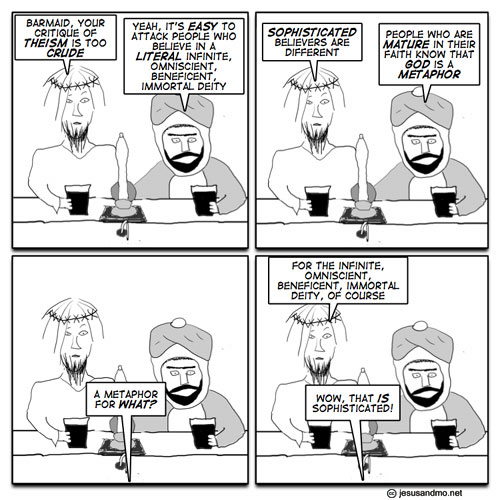
Religious thought, writing, and speech, at its adult level, is always metaphorical.

He is actually delivering a similar insult to the one PZ does, but this time it's cloaked in the velvet glove of tolerance. Of course, it depends on what "metaphorical" means in this context. Mark Kleiman explains:

"Humans are created in the Image of God," taken literally, is nonsense, if you remember that it is a part of a religious tradition that says that God is an infinite, omniscient, beneficent, immortal being "without parts or passions," which is the opposite of finite, finitely rational, ethically challenged mortal beings with physical bodies and emotional drives.

In other words, Mark Kleiman thinks that people who talk about a literal, personal God are being childish (it's not adult level). This kind of ignorant tolerance is, in some ways, more insulting than informed bigotry because it denies that the "childish beliefs" are of any significance or importance.

Saturday, July 14, 2007

The Blogosphere's most pathetic excuse for a human brain -- A contest


If someone had asked me: "Who is the most ignorant twit, the most delusional, lied to, pathetic excuse for a thinking human being in the blogosphere?" A couple days ago I would have said it was Future Toddler Chopper, Vox Day.

I would have been wrong.

No, the most ignorant twit, the most delusional, lied to, pathetic excuse for a thinking human being in the whole English language blogosphere might just be Tristan J. Shuddery of the "STR : THE FREEDOM BLOG." This guy would either think Stephen Colbert is serious and too liberal or he's got his own kind of "The Colbert Report" satire-blog going.

Now some of you might think Tristan J. Shuddery can't be for real, but if he's not for real he has fooled Conservapedia. Now, I ask you, would Conservapedia be telling us that Shuddery obtained a PhD in Faith-based software-development from Patriot Bible University if they hadn't checked to see if there was a Patriot Bible University and a Faith-based software-development program?

Not only that, on this website, Tristan J. Shuddery himself assures us that his blog is no satire:
Friend,

I can assure you that my web-site, ShelleyTheRepublican.com is NOT a satire. We are a mainstream news/commentary site dedicated to promoting mainstream American opinion, along with traditional Christian family-values.

I know you atheists like to laugh at everything, but please save your giggles for somebody else. You liberals seem to think that just about everything is satire.

That "Friendly Atheist" you mention has ran a campaign of hate against STR.com for almost six months. We are in the process of litigation against him for his outrageous and vile insults against Ms Goodman, her business and the Holy name of Jesus Christ.

Yours,

Tristan J. Shuddery

(Associate Editor, ShelleyTheRepublican.com)

But, just in case I'm wrong I'm going to make this a contest -- can you find a more ignorant twit than Tristan J. Shuddery in the whole blogosphere?

If you can, then use the comments section of this post to link 3 posts from the blog you think is dumber than Shuddery's and high-light some of its most ignorant claims.

For example, here are three links to posts on STR : THE FREEDOM BLOG:

1) Henry Potter Breaks All Ten Commandments

He means "Harry Potter," calling him Henry is either clueless ignorance (perhaps to be corrected soon) or a dumb joke. A real, but bad, joke would be to spell it "Hairy Potter."

2) Compassionate Conservatism & The Leader George W. Bush

Nothing needs to be said here, just read it and laugh.

3) Hitler the Atheist

According to this ignorant twit, atheists and neo-Darwinists believe:

10,000 years ago a catastrophe happened between the Moon and the Earth, with floods and fires , causing a calamitous collapse of the golden civilisations which existed then, and leaving just a few people alive on the world, who were able to find higher ground.

But, to give the guy some credit, Tristan J. Shuddery does have one good argument against Darwinian evolution -- his own existence! If Darwinian survival of the fittest is true, then how come this pathetic excuse for a thinking human being is still alive?


Wednesday, July 11, 2007

More of Orson Scott Card's anti-atheist bigotry


Orson Scott Card's newest, "Other Mormons Didn't Accept Me," is up. It has some more anti-atheist quotes:

America is the most religious Western nation — but surely Dr. Mohler sees that our children can hardly get a college degree without being indoctrinated, not just in atheism, but in hostility to all organized religions, Christianity in particular.

Oh, no! Send a kid to college and he might meet an atheist! This stuff about being indoctrinated is just bigoted BS. Would Mr. Card object to academic views and practices on religion being diverse? Believers outnumber atheists and agnostics, and plenty of professors can be found regularly attending religious services.

Mr. Card is making an appeal to Dr. Mohler's bigotry. But I guess there is a bit of hostility that comes from realizing you've been lied to for most of your young life. However, the evidence is the evidence and it is against religion.

When professors tell our children that all religions are outmoded, that Christianity belongs in the dustbin of history, that all evils in history have been caused by fanatical believers in some religion — do you think it matters to them whether the religion they're rejecting is Orthodox Judaism, evangelical Christianity, Catholicism, or Mormonism?

Well, I live in a world where most people tell me lies about Hitler being an atheist, about how I'll be damned to Hell if I don't believe some crazy thing and more crazy stuff. It's not changing my opinion. Maybe if there were a way Mr. Card could make a real case he could be safe in a world where other people have different opinions? Maybe if his truth could be reached through critical thought it wouldn't matter what other opinions people had.

The message of Christ is today proclaimed into the ears of an increasingly hostile world. Whether from jihadist Islam or jihadist atheism, we are beleaguered on all sides and none of us has the majority.

Jihadist atheism?! Are we flying planes into buildings? Are we shooting abortion doctors or blowing up family planning clinics?

Returning to the example of Gov. Romney, I wonder if there is a Christian denomination on earth that would not be proud to claim as a member of their church a man who is so faithful to his wife and devoted to his children, so abstemious in his personal habits, so consonant to his expressed ideals?

I'm happy to see that Card wouldn't vote for Ronald Reagan. Reagan was, after all, a presidential candidate who was divorced, had estranged relations with his children, never saw his grandchildren, rarely attended church, strongly opposed a law to ban gays from teaching school, and as governor signed the nation’s most liberal abortion law.

And according to George F. Will, "Three Good Options for The Right":

Suppose someone seeking the presidential nomination had, as a governor, signed the largest tax increase in his state's history and the nation's most permissive abortion law. And by signing a law institutionalizing no-fault divorce, he had unwittingly but substantially advanced an idea central to the campaign for same-sex marriages -- the minimalist understanding of marriage as merely a contract between consenting adults to be entered into or dissolved as it suits their happiness.

Question: Is it not likely that such a presidential aspirant would be derided by some of today's fastidious conservatives? A sobering thought, that, because the attributes just described were those of Ronald Reagan.


Back to Mr. Card:
But we accept every word of Christ in the New Testament.

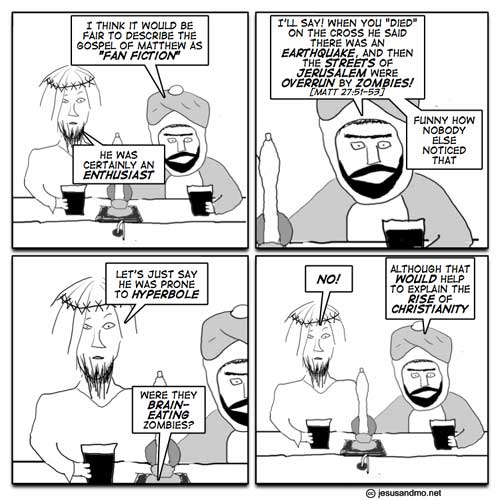
They do? They believe demons can live in people and be cast into pigs? What about Matthew's zombies?

When Christianity is once again seen — correctly, I might add — as the nurturing mother of democracy and freedom throughout the world, ...

Gee, didn't those pagan Greeks come up with democracy while the Hebrews were living in a theocracy?


Sunday, July 8, 2007

Atheist vs. Atheist


David Sloan Wilson has an article in the eSkeptic, "Beyond Demonic Memes," (the same article is on this blog), that attacks some of Richard Dawkins' speculations in The God Delusion. For example, Dawkins speculated that religion is "just" a side-effect of children's uncritical acceptance of their parents' beliefs and teachings.

Mr. Wilson sees a more complex and adaptive role for religion and he criticizes Dawkins for dismissing groups selection as an evolutionary factor. It has little to do with religion. Dawkins has always, and in all his works strongly resisted group selection, no matter the context.

I tend to agree with Mr. Wilson's ideas about a more complex and adaptive role for religion. I encountered the concept of group selection in The Lucifer Principle: A Scientific Expedition into the Forces of History by Howard Bloom. The Official website for the book has two sample chapters, Superorganism and Isolation that introduce some of the concepts.

But Mr. Wilson also makes an ad hominem attack saying that Dawkins is "just another angry atheist, trading on his reputation as an evolutionist and spokesperson for science to vent his personal opinions about religion." Dawkins doesn't really come off as angry, at least he is not as angry as I am. I'm far more pissed off at the lies and the blinders of religion's advocates than Richard Dawkins.

There's a lot to be angry about if you're an atheist in America, just look at the other posts on my blog. A religion usually benefits its own believers to the detriment of the non-believers, it tends to make people more compassionate towards their co-religionists, and less compassionate towards the heretics and infidels they use as scapegoats.

Mr. Wilson is also taking money from the Templeton Foundation. This fact might distort Mr. Wilson's conclusions. Just because religion is adaptive doesn't mean it is good for us. If it really is putting blinders on delusional believers then they'll suffer too for their lack of contact with, and understanding of, the real world. Truth matters and the Templeton Foundation is committed to finding some kind of metaphysical truth in religion. Remember what kind of world we are adapting to, a world of continual war and predation.

Check out the Barefoot Bum's posts "Wilson on Dawkins" and "Statistical fallacies" and also the comments on Stranger Fruits' "Wilson on Dawkins" for more information on the arguments that have been going on.

The Barefoot Bum does not think Wilson correctly uses statistical methodology, the Bum accuses Wilson of presenting statistical concepts in a way that harms rather than helps the reader's statistical intuition.

UPDATE: Richard Dawkins Replies to David Sloan Wilson.

UPDATE II: The electronic ghost of Douglas Adams Replies to Richard Dawkins and David Sloan Wilson via a 1998 speech called 'Is there an Artificial God?':
"So, my argument is that as we become more and more scientifically literate, it's worth remembering that the fictions with which we previously populated our world may have some function that it's worth trying to understand and preserve the essential components of, rather than throwing out the baby with the bath water; because even though we may not accept the reasons given for them being here in the first place, it may well be that there are good practical reasons for them, or something like them, to be there. I suspect that as we move further and further into the field of digital or artificial life we will find more and more unexpected properties begin to emerge out of what we see happening and that this is a precise parallel to the entities we create around ourselves to inform and shape our lives and enable us to work and live together. Therefore, I would argue that though there isn't an actual god there is an artificial god and we should probably bear that in mind. That is my debating point and you are now free to start hurling the chairs around!"


Vox the Knife wants your Anti-Christian arguments


Future Toddler Chopper, Vox Day, wants your Anti-Christian arguments.

So far all he's got are these pathetic sound bites:

1. A loving God wouldn't send anyone to Hell.
2. Omnipotence-Omniscience conflict. (I thought knowledge WAS power.)
3. The problem of evil.
4. Euthyphro.
5. I don't like God / If God exists, I wouldn't approve of him anyhow.
6. I believe in one less god than you.

Vox is either too lazy to do a Google search for "Arguments Against God," and "Arguments Against Christianity," or, Vox is trying to psych-out his readers and find out where he can debate them on his blog. What do you think?

I haven't got time to play this game, but if any of my readers want to play, use the comments section for this post to report on your progress. Vox isn't your normal Christian, he's less honest and far crazier.


Thursday, July 5, 2007

Orson Scott Card's anti-atheist bigotry


Orson Scott Card has an article on Beliefnet called "Who Gets to Define 'Christian'?" It was written in response to Dr. R. Albert Mohler, Jr.'s "Mormonism Is Not Christianity."

Card's lies and anti-atheist bigotry are on full display in this single paragraph:

We Mormons don’t agree with you on many vital points of doctrine. But I hope we all agree with each other about this: In a time when a vigorous atheist movement is trying to exclude religious people from participating in American public life unless they promise never to mention or think about their religion while in office, why are we arguing with each other?

A vigorous atheist movement? I wish! We're only about 3 percent of the American population, 9 percent if you include everyone called "non-religious." We're the least trusted group according the polls. At best only 45 percent of the population would vote for an atheist, and that's the bigotry Mr. Card wants to plug into.

Sure, some atheist books have ascended to the top of national bestseller lists. Christopher Hitchens’s God Is Not Great: How Religion Poisons Everything has, since its May 1 publication, sold 58,000 copies, according to this Publishers Weekly article. Richard Dawkins’s The God Delusion, published last September, has sold 282,000 copies. The population of the United States is 301,139,947. Can you do the math Mr. Card? How do their sales compare with the sales of Tim LaHaye's and Jerry B. Jenkins' "Left Behind" books which have sold more than 62 million copies.

And according to Mr. Card this atheist movement is "trying to exclude religious people from participating in American public life unless they promise never to mention or think about their religion while in office." Where the hell does that even come from? How exactly are we trying to exclude religious people or silence them? By pointing out how crazy their statements are?

I'll admit that I'm a bit disgusted by all the god-blathering politicians have to do to get elected but there is a kind of god-blathering I consider "safe and sane enough" to vote for. For example, John Kerry's semi-quoting of Lincoln's "we pray that we are on God's side and not blaspheme and claim he is on our side," by saying: "I don't want to claim that God is on our side... I want to humbly pray that we are on God's side." Does Mr. Card think only a secretly crypto-atheist would say such a thing? John Kerry was accused of secretly being an atheist in addition to getting swift-boated.

There is, however, another kind of god-blathering I don't consider safe or sane, such as Kansas Senator and presidential candidate Sam Brownback's New York Times Op-Ed, "What I Think About Evolution," and Rep. Ben Bridges' and Rep. Warren Chisum's memo that called for the end of “tax-supported evolution science” because it has a religious agenda to name a few examples.

Does Mr. Card know the difference between safe and sane god-blathering and dangerously insane god-blathering? Or does the more god-blathering a candidate does make him a better candidate in my Mr. Card's mind? He doesn't seem like someone who would connect the Christian Right to the rise of American Fascism.

Then Mr. Card notes how "Christians" fight among themselves rather than defeat this dangerous atheist enemy. Like we atheists don't argue among ourselves?

Remarkably, Mr. Card inserts that paragraph just a few paragraphs after writing this:

We are as legitimate, as citizens and therefore as potential officeholders, as anybody else in America. Because there is no religious test for holding office in America.

And if you try to impose one, by saying that all persons belonging to this or that religion should never be elected president, then who is it who is rejecting the U.S. Constitution? Who is it who is saying that people with certain beliefs are second-class citizens, for no other reason than their religion?

You want to know who is it who is saying that people with certain beliefs are second-class citizens? How about the Democrat Mr. Card warning Republicans of a vigorous atheist movement that is trying to exclude religious people? Yea, right, 3 to 9 percent of the U.S. voters are going to exclude you Mr. Card. We can't even get most of the younger ones to vote at all they're so disgusted by politics.

If anyone is excluded as potential officeholders it's us atheists and it is in part because of liars like Mr. Card. Mr. Card who thinks he can make Mitt Romney acceptable to Republicans by repeating the magic word, "Jesus."

What if we define “Christians” the way most people would: “Believers in the divinity of Christ and in the necessity of the grace of Christ in order to be saved in the Kingdom of God.”

Or, “People who believe Christ is the Son of God and the only way to please God is by following Christ’s teachings as best you can all your life.”

Or how about, “People who believe that the New Testament is scripture and that its account of the life, death, resurrection, and teachings of Jesus is true and that we should act accordingly.”

We can come up with a lot of definitions that do a much better job of describing what most people mean when they use the word “Christian.”

How many ordinary Christians actually know or care about the “historic creeds and doctrinal affirmations” that form Dr. Mohler’s definition-of-choice?


That's what I would call mumbo-jumbo. Mr. Card repeatedly uses the magic, saving words, "Jesus," "Christ," "Christian," "New Testament," "God" and "Son of God" while being vague about the underlying details of what is believed about Jesus. Does he believe that Jesus cast demons out of a man and put them in pigs? Does he believe his faith can literally move mountains? Does he think Jesus came from a planet near a star called Kolob? Does he think "Christians" should establish an American theocracy? (Well, he probably doesn't but a number of the Republicans Mr. Card wants to reach probably do.)

Does Mr. Card care what some Christians he might vote for believe? If religious faith is so important would he vote for Osama bin Laden before he voted for an atheist? Interestingly, Mr. Card, a Democrat, decided to contrast Bill Clinton with George Bush:

How then would we find out what he really believes? What his standards are? How well he keeps his commitments? It’s not impossible to determine that even with people whose religious commitments are, shall we say, skin deep. It wasn’t hard to find out what Bill Clinton’s standards of truth-telling and word-keeping were before he was elected; he absolutely performed exactly as his past behavior had given us reason to expect. We got what we voted for.

So, Bill Clinton's god-blathering wasn't good enough for the Democrat Mr. Card? Did he vote for George Bush of whom he says:

Think about it. How often has President Bush been mocked because he believes he was born again? How often have his critics ridiculed him because he believes that when he prays, God hears him and even, sometimes, answers?

You mean that guy who got elected president twice in spite of being mocked and whom many people would now like to see impeached?

The president who just recently commuted Scooter Libby's sentence after saying this about the commutation process? Yea, right, Georgie has been a great example of a faithful president.

His profession of membership in a Church gives us a way to find out about the standards of good and evil, of right and wrong, that his religion teaches.

Umm... like we learned about George Bush's standards of good and evil, of right and wrong, that his religion teaches?

What I'd like to know about a presidential candidate is how they define the difference between good and evil because that's how you tell if they've fallen victim to the Manichean delusion. The Manichean delusion is the self-anointing of "us" as good and "them" as evil. Everything you do is good, everything your proclaimed enemy does is evil.

Just using the words Mr. Card does here, their paring, "good and evil," is a clue to his having become a victim of the Manichean delusion himself, because the opposite of "good" is not "evil" -- the opposite of "good" is "bad." Good is something that fulfills its role well, a sharp knife is a good knife, a dull knife is a bad knife. The opposite of "evil" is "love." Love is nurturing and caring and helping while evil wants to kill and cause pain, cause damage, halt plans.

The problem with such a non-Manichean definition is that doing evil can be a necessity in war.

Where I would be worried is when we have a candidate who does not profess any religion, or does not live up to the standards of the religion he professes.

In other words, Mr. Card is one of those many people who would not vote for an atheist and just might prefer Osama bin Laden as our president. Well, that might not be fair, but he sure doesn't seem to be warning those Republicans away from the Pat Robertsons, the James Dobsons and others.

Monday, July 2, 2007

Al Sharpton admits the Bible is a bunch of crap

Christopher Hitchens and Al Sharpton had a debate on TV's Hardball a few days ago (video of the event can be found here and here) and during that debate Hitchens started pointing out things like how bad the Ten Commandments are and how it's absurd to think the place Moses and the Hebrews had just left, Egypt, didn't have its own laws and ethics. Al Sharpton pooh-poohed Hitchens points saying that's just religion, not God. Hitchens was basically saying the Bible was a load of crap and Sharpton didn't argue that point. I wonder why Hitch didn't point that out and ask Sharpton, "are you a deist or a Christian?" If Sharpton isn't going to defend the Bible, then where does he get his vision of what God is?

Al Sharpton backed off into a position that, for all we know from his current argument, could have been a deist position or a Hindu position or a Muslim position. He did not defend the Bible because he knew he couldn't. This a common tactic used by modern Christians in these debates. Christians, as well as Jews and Muslims, need to be called on it. Al Sharpton is supposed to be a Pentecostal, not a deist, Hindu or Muslim. His autobiography is even called "Go and Tell Pharaoh."

By not dealing with Hitchens Biblical criticism, by explicitly dismissing it as "just religion - which could be wrong" he leaves behind anything that could define what he meant by God. What is God if not defined by a religion? A Christian really can't be dismissing the Bible and criticism of it as "just religion." It's suppose to be his religion.

If you agree, then the next time you use the name "Al Sharpton" make it a link to this blog post so that its title: "Al Sharpton admits the Bible is a bunch of crap" shows up on a Google search for Sharpton's name. Or, write your own Sharpton blog with a similar title and I'll link you.

Sharpton accused Hitchens of attacking religion rather than God, but the whole idea of what God is which is espoused by Christians, Jews and Muslims comes from that Old Testament description which includes giving the Hebrews the Ten Commandments. Other religions, like Buddhism, don't necessarily have a God concept.

Hitchens' book is called "God is not Great" and Sharpton fixated on it. But since Hitchens doesn't believe in god, it is clear that he is really criticizing religion, not a God that doesn't exist except as a concept in such religions.

I'd have to admit to being somewhat agnostic about some kind of "intelligence" underlying "creation." But any assertion beyond "maybe there was an intelligence that designed the universe" requires evidence, and that's where all religions go off into crazy land. They go too far in making claims for that "intelligence" that they have no right to make. The definition Sharpton wanted to use is too minimal to mean anything religious and can't be argued with, we can only argue against the mentally anthropic projections people put on the cause of the universe, those assumptions that some entity "desired," "planned," "wanted," "willed," and "designed" this universe. It could be Einstein's God they mean and Richard Dawkins dealt with that one in his book.

Hitch should have just said "yes, I'm arguing against religion not God. Are you or are you not religious? What is religion to you any way?"