

Sunday, June 29, 2008
Dawkins does Who
Larger version here.
The episode is called, "The Stolen Earth," and the Earth is stolen from its orbit and placed in another galaxy with 26 other stolen planets. I suppose it's a bit odd that when the earth is stolen and moved across space that they ask advice of a biologist. You'd think they would get an astrophysicist, like Neil De Grasse Tyson. Maybe the daleks exterminated all the astronomers. Or maybe it's because all scientists in TVland are superscientists who know everything, just like Gaius Baltar.
Not too bad, but don't give up your day job Richard:


Tuesday, June 17, 2008
The Gaius Baltar Award for Moral Cowardice
There's a post on my favorite Battlestar Galactica forum called "The Gaius Baltar Award for Moral Cowardice." The author quotes this passage from an interview with Galactica's James Callis, he plays Baltar:
I like that idea and I've got a nomination to make.
SF Gate has this article, "Killer dad said he had to 'get the demons' out," that mentions the fact that some drivers passed by as they watched a man kicking and stomping a two year old to death.
Well, at least that couple called the cops, or someone did, but shit! How do you watch a guy kick around a small child and not do anything? I wonder how many rubber-neckers drove by and didn't do anything? Why not take a tire iron to the guy's face so he stops kicking his son? How do you stand there and watch a man beat a toddler to death?
I'd like to nominate everyone who drove by that scene and did nothing with a Gaius Baltar Award for Moral Cowardice.
UPDATE:
Someone calling themselves "GothicJossMinion" nominated all the countries where this is still okay...and not just okay but honored:
Let's Watch A Girl Get Beaten To Death.
They win.
I think that there should be a Gaius Baltar Award for Moral Cowardice given out to people every year. And this man—it's just, seriously, reading it, I was like, "Christ, this guy is Gaius Baltar!" He's a schoolteacher. The earthquake hits. And he said, "Stay still, everybody, you'll be fine," and just ran! He ran for his life, without any of the kids who he's supposed to be looking after. And the miracle of it is that the earthquake didn't touch his school in the same way. He went back to the class, and they're all alive, thank God. And they were like, "But teacher, why did you run away?" And his replies are just extraordinary. It's like, "I'm not a brave man. I am a coward. And in situations like this, it's every man for himself. I don't really feel very guilty, because I didn't cause the earthquake, and quite frankly, if it had been my own mother sat next to me, I would have left her as well."
I like that idea and I've got a nomination to make.
SF Gate has this article, "Killer dad said he had to 'get the demons' out," that mentions the fact that some drivers passed by as they watched a man kicking and stomping a two year old to death.
McKain, of Crows Landing, said she drove past Sergio Aguiar's pickup Saturday night on West Bradbury Road and, at first, thought he was "kicking garbage or something."
But she said her boyfriend, Dan Robinson, told her to back up and put her headlights on Aguiar.
"Sure enough, he was kicking a baby around," McKain said.
Well, at least that couple called the cops, or someone did, but shit! How do you watch a guy kick around a small child and not do anything? I wonder how many rubber-neckers drove by and didn't do anything? Why not take a tire iron to the guy's face so he stops kicking his son? How do you stand there and watch a man beat a toddler to death?
I'd like to nominate everyone who drove by that scene and did nothing with a Gaius Baltar Award for Moral Cowardice.
UPDATE:
Someone calling themselves "GothicJossMinion" nominated all the countries where this is still okay...and not just okay but honored:
Let's Watch A Girl Get Beaten To Death.
Last month seventeen year old Dua Khalil was pulled into a crowd of young men, some of them (the instigators) family, who then kicked and stoned her to death. This is an example of the breath-taking oxymoron “honor killing”, in which a family member (almost always female) is murdered for some religious or ethical transgression.
They win.
Friday, June 13, 2008
You maniacs! You blew it up! Damn you! Damn you all to hell!
Did the ending of "Revelations," the mid-season finale of the 4th season of Battlestar Galactica (last episodes will air in 2009 after a hiatus), remind you of anything?
It reminded me of Adama's speech in the very beginning, in the miniseries, when he asked, "does humanity deserve to survive?" There was a hint there that even after the genocide and the Cylon war that there would still be something human beings were in some sort of denial about, something in their nature and the inevitable consequences of their thought processes and their resulting acts. Here on this nuclear ravaged version of Earth they will probably confront whatever "original sin" they had also stained Earth with.
Hopefully the sin will be more original than the past cliché "sins of humanity" scifi writers want to accuse us of, you know, eating from the tree of knowledge (wanting to know things man was not meant to know), building towers to heaven (getting too close to God-like), wanting to bugger angels...
As I pointed out in my post about Galactica falling into the old "machines destroy their makers cliché". The Frankenstein, golems and Rossum's Universal Robots were just the tip of the iceberg. Here is another example of machines pissed off at humanity that I now think might hit closer to home:
You know who makes those machines possible:
Scientists make those machines possible:
A quick recap, the Cylons, now lead by D'Anna, took Roslin, Baltar and the others aboard the battered rebel basestar hostage to bargain the four hidden Cylons on the Galactica out of hiding. Tory uses the President's medication as an excuse to go to the basestar and join up with her "brothers and sisters," even telling Roslin "she doesn't take orders from her anymore," but the other three remain anonymous.
Colonel Tigh then admits to Admiral Adama that he is a Cylon and offers himself as a hostage. They can now threaten to airlock him. Adama tells Tigh to "get his damn, dirty Cylon paws off of me" and then has a psychological break down and even punches a mirror, making his fist bleed... Did that remind you of anything?
It reminded me of Willard (Martin Sheen) in Apocalypse Now and I think it has close to the same meaning. Willard also punched his fist into a mirror, destroying himself symbolically.
Lee, while Tigh is in the airlock, gets Tigh to rat out Sam and Tyrol, and I suspect Tory too. There is a melodramatic standard old standoff with Tigh in an airlock on Galactica, waiting to be sucked out into the vacuum of space, and the Cylons aiming nuclear weapons at the Colonial ships. Anybody tries anything, and everybody dies. It's resolved when Starbuck learns that her old Viper is now pointing the way to Earth. She stops Lee from airlocking Tigh and then everyone decides they'll go to Earth together, as one big happy family, not as enemies.
They all jump to Earth and have a celebration. Then they discover that the planet is a radioactive shit-hole. There's no animal or plant life to be seen, except maybe a few weeds growing among the rubble. Nobody feels like celebrating now (though there is one person with a smile on their face) as the camera sweeps over a matte painting of the devastated ruins.
So... What happened to Earth? Who blew it up? And why?
We probably did, us "undeserving of existence" humans, it's our not-so "original sin" if they can't come up with something better over the break.
It reminded me of Adama's speech in the very beginning, in the miniseries, when he asked, "does humanity deserve to survive?" There was a hint there that even after the genocide and the Cylon war that there would still be something human beings were in some sort of denial about, something in their nature and the inevitable consequences of their thought processes and their resulting acts. Here on this nuclear ravaged version of Earth they will probably confront whatever "original sin" they had also stained Earth with.
Hopefully the sin will be more original than the past cliché "sins of humanity" scifi writers want to accuse us of, you know, eating from the tree of knowledge (wanting to know things man was not meant to know), building towers to heaven (getting too close to God-like), wanting to bugger angels...
As I pointed out in my post about Galactica falling into the old "machines destroy their makers cliché". The Frankenstein, golems and Rossum's Universal Robots were just the tip of the iceberg. Here is another example of machines pissed off at humanity that I now think might hit closer to home:
You know who makes those machines possible:
Scientists make those machines possible:
A quick recap, the Cylons, now lead by D'Anna, took Roslin, Baltar and the others aboard the battered rebel basestar hostage to bargain the four hidden Cylons on the Galactica out of hiding. Tory uses the President's medication as an excuse to go to the basestar and join up with her "brothers and sisters," even telling Roslin "she doesn't take orders from her anymore," but the other three remain anonymous.
Colonel Tigh then admits to Admiral Adama that he is a Cylon and offers himself as a hostage. They can now threaten to airlock him. Adama tells Tigh to "get his damn, dirty Cylon paws off of me" and then has a psychological break down and even punches a mirror, making his fist bleed... Did that remind you of anything?
It reminded me of Willard (Martin Sheen) in Apocalypse Now and I think it has close to the same meaning. Willard also punched his fist into a mirror, destroying himself symbolically.
Lee, while Tigh is in the airlock, gets Tigh to rat out Sam and Tyrol, and I suspect Tory too. There is a melodramatic standard old standoff with Tigh in an airlock on Galactica, waiting to be sucked out into the vacuum of space, and the Cylons aiming nuclear weapons at the Colonial ships. Anybody tries anything, and everybody dies. It's resolved when Starbuck learns that her old Viper is now pointing the way to Earth. She stops Lee from airlocking Tigh and then everyone decides they'll go to Earth together, as one big happy family, not as enemies.
They all jump to Earth and have a celebration. Then they discover that the planet is a radioactive shit-hole. There's no animal or plant life to be seen, except maybe a few weeds growing among the rubble. Nobody feels like celebrating now (though there is one person with a smile on their face) as the camera sweeps over a matte painting of the devastated ruins.


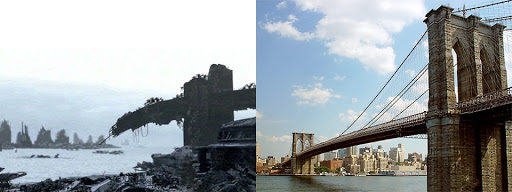
So... What happened to Earth? Who blew it up? And why?
We probably did, us "undeserving of existence" humans, it's our not-so "original sin" if they can't come up with something better over the break.
Monday, June 9, 2008
Baltar's confession
The blog carnival is now posted here.
Submit your own reviews to the BSG carnival here.

After being disappointed with the last episode, with the near trashing of Romo, we finally got a really good one. It had everything, a lot of Baltar, important revelations, Baltar trying to talk to a hybrid, kick-ass battle scenes, Baltar evangelically witnessing to a Cylon toaster, major plot-driving events... and did I mention a heavy dose of Baltar? He even confesses to Roslin about how he gave the access codes to the Cylons and nearly destroyed humanity. However, its not like the old days when he was the whole story, that confession turns out to be one the lesser plot-driving events of this episode.
The episode started by flashing back to two days before Lee faced down Romo's four barreled pop-gun to become the interim President. We got to see what happened right after the rebel basestar jumped away. First thing to note is that Cylon basestar jumps have a weird effect on Roslin. She gets scrooged for being a scheming, unloving, pigheaded hard ass by getting visits from the Ghost of Christmas Yet to Come, or Head Elosha, every time the basestar jumps.
The first time Roslin visited jump-space she got a subtle change of wig hair and found herself wandering the desolate halls of the Galactica where she finds Elosha, her long dead spiritual adviser. The Hybrid quickly jumps again and Roslin's vision continues from where it left off: The Galactica is devoid of people except for Head Elosha and Roslin seeing herself dying of cancer in her hospital bed. Head Elosha then goes all Ghost of Christmas Yet to Come on Roslin. When the Basestar reappears in real-space, the vision ends and Roslin is back on the rebel basestar looking at a babbling hybrid (what a job for an actress, you sit in a tub of goo all day and act weird while babbling semi-nonsense).
One of the 8s (the Boomer/Athena model) tells them that the hybrid does what she wants and she thinks the basestar is jumping because something happened to Natalie (Whoa! the speculation back on Galactica last episode was right.) They also can't unplug the Hybrid, so Baltar tries to talk to the hybrid as if he's trying to comfort a young child so that she'll quit jumping. It was rather amusing I thought, Baltar has become more arrogant and comically overconfident now that he thinks he has found God. At one point he even claims he has made a "spiritual connection" with the Hybrid for he appears to have gotten her to quit jumping. But no, the Hybrid jumps again. Roslin pops back into delusion-space and she sees Thrace, Cottle and the Adamas standing over her bed. Elosha is still doing the Ghost of Christmas Yet to Come act on Roslin telling her things like: "Don't you just hate these people?" And "At least you haven't taken that [their empathy] from them." And "You don't make room for people."
One of the 8s, the Sharons, figures out that the Hybrid is following the Hub so the attack on it is still on. Helo comes up with a risky plan where the vipers go in without power, they're towed on cables by Cylon heavy raiders, so they won't be detected. The 8 and Helo will sneak on to the Hub while the Vipers cripple it, and once they have D'Anna they'll nuke it. It's a risky move, and while Helo struggles with the risk evaluation the 8 massages Helo's back and Helo notes that Athena only learned to do that after meeting him. The 8 admits that she got curious about Athena and Hera and downloaded her memories. She doesn't mean for it to sound creepy. She says she doesn't want it to be strange, but how can it not be? It means that Helo is possibly living with at least several dozen look-alikes of his wife some of whom might also remember making love to him and all their other intimate moments. He handles it well, so far, but this has potential for a great Helo story in the future. What if when they're back on Galactica one of the not-Athena 8s decides to sleep with Helo and Athena catches them?
Roslin has a secret meeting with Helo and orders Helo to bring D'Anna straight to her first, which is a betrayal of the plan they agreed to with the Cylons. Helo objects and this is where Helo's character starts to get tested. Helo expresses reservations, he thinks the 6s and 8s are trustworthy (but we know from a previous episode they were planning their own betrayal). If D'Anna really does know the identities of the Final Five, Roslin doesn't want the Cylons listening in on it. On the surface Roslin's plan sounds stupid, they are guests on the basestar, probably outnumbered, and this would be a big betrayal of their deal with the rebel Cylons. However, Helo is a soldier first and commanders of soldiers can give orders without explaining them. You're obliged to trust them and hope they know what they're doing. That's why Helo let Starbuck go a little crazy until she wanted to bet the farm on her visions and he had to mutiny.
How much damage do you let your superiors do before you rebel? It's one of those questions we see being asked by people like former White House Press Secretary Scott McClellan.
Meanwhile, on the Resurrection Hub, one of the 1s, that's the Cavils, has just unboxed D'Anna and he tells her about the "shameful" civil war -- the one his models started. He's brought her back so she can stop the Cylons from battling one another.
Back on the rebel basestar, the Hybrid reveals that a D'Anna has been unboxed and jumps (Another whoa! Those Cylons must have some powerful wifi networking going on to get that kind of live update while the colonial humans are still using analog radios). Roslin is again back in dream-space walking the hallways of Galactica and speculating that Elosha and the visions are a manifestation of her subconscious. Roslin and Elosha see Admiral Adama reading Searider Falcon to the dying Roslin. The first time I heard this (I had to watch this episode twice) Once I heard the word "scar" I thought of the Cylon called Scar and heard the word "Cylon" instead of hearing the word "island" so I thought the whole book reading was part of Roslin's delusion (I kind of wish it were because what I thought I heard the first time sounded better).
Back in reality, after the jump, while everyone else is busy attacking the Hub, Baltar finds one of the chrome toaster models, one the Centurions, and tries to evangelically witness to it. He thinks he can make an ally out of it apparently. Baltar tells the Centurion that he's noted a certain hierarchy and that the Centurions seem to be on the bottom. He asks the Centurion if they've told him about God and how "God doesn't want any of his creatures to be slaves." Oh, God doesn't want anyone to be a slave? Then why were there ever any slaves? And Baltar knows what God wants? How? Later Baltar's own logic should betray him on that point. It's also an indication that Baltar doesn't get AI after Allen Turing and the algorithmic approach to it.
On the Resurrection Hub, Boomer comments on the arrival of the rebel basestar and tells Cavil that the basestar has launched a bunch of Heavy Raiders. Cavil correctly concludes that the rebels are attempting to destroy the Hub, and doing so would be mass murder and would make death permanent for Cylons. Hearing that, D'Anna grabs Cavil by the neck and rams his head into the side of her goo-tub, killing him. Payback, no doubt for getting boxed.
Missiles destroy a node at the top of the Hub, taking out its FTL capability. Helo's Raptor heads towards the Hub and there he and the 8 find D'Anna and the dead Cavil. Helo tells D'Anna to run and grabs her arm. Once off the Hub, Helo announces that he has D'Anna and orders a nuclear strike on the Hub.
While Baltar continues to talk to the Centurion the rebel basestar is hit by a missile and the explosion destroys the Centurion and injures Baltar. (Jesus Christ On A French Fry!! Didn't Jesus get wounded in the side by a Centurion, pierced by a spear? Do you think they were doing Jesus symbolism on purpose?)
Baltar then finds himself in Roslin's care, alone with her. She has a First Aid kit and she bandages Baltar up and injects him with morpha. As the morpha takes effect, Baltar tells Roslin she needs God, and then about how he once harbored a terrible guilt that God took away. Roslin keeps asking "What guilt?" and Baltar finally admits that he gave the Cylons the access codes prior to the nuking of the Colonies. (Ohhh, is he going to regret that in the morning.)
Roslin starts to tremble subtly and Baltar tells her how the guilt went away when he realized that "God made the man who made that choice" so it was really God's choice. He talks about "the flood Pythia spoke of," which wiped out most of humanity. Hmmm... getting a bit of Biblical myth in there. I wonder if there's a Noah and the ark story in Pythia?
Baltar has realized that the concept of an omniscient and omnipotent God is a good way to absolve all guilt for any action. John Hagee, the controversial evangelical leader who endorsed John McCain, argued something similar for Hitler in a late 1990s sermon by saying that Hitler was sent by God, tasked with expediting God's will of having the Jews re-establish a state of Israel:
And Hitler, according to recorded speeches and his book, would have agreed with the doing of God's work part:
"My feelings as a Christian points me to my Lord and Savior as a fighter. It points me to the man who once in loneliness, surrounded only by a few followers, recognized these Jews for what they were and summoned men to fight against them and who, God's truth! was greatest not as a sufferer but as a fighter. In boundless love as a Christian and as a man I read through the passage which tells us how the Lord at last rose in His might and seized the scourge to drive out of the Temple the brood of vipers and adders. How terrific was His fight for the world against the Jewish poison. To-day, after two thousand years, with deepest emotion I recognize more profoundly than ever before in the fact that it was for this that He had to shed His blood upon the Cross. As a Christian I have no duty to allow myself to be cheated, but I have the duty to be a fighter for truth and justice.... And if there is anything which could demonstrate that we are acting rightly it is the distress that daily grows. For as a Christian I have also a duty to my own people.... When I go out in the morning and see these men standing in their queues and look into their pinched faces, then I believe I would be no Christian, but a very devil if I felt no pity for them, if I did not, as did our Lord two thousand years ago, turn against those by whom to-day this poor people is plundered and exploited."
- Adolf Hitler, in his speech in Munich on 12 April 1922
If God knows everything we will do before we do it then we don't really have the freedom to do anything otherwise, our actions must be determined by all our experiences, nature and nurture and the type of soul given us etc.. If we could do something God had not foreseen, then God's total knowledge would have been incomplete and he couldn't be called omniscient. Therefore, either God knows all and everything is preordained (free will is an illusion) or God doesn't know the future.
If God knows everything then He knew before He created mankind that Baltar would mistakenly betray mankind, that Hitler would wipe out millions of Jews and that for hundreds of years slavery would be a Roman and Greek institution. God created everything, predetermined. He knew what they would do in the future just the way an expert pool player can cause a chain reaction of events that puts exactly the ball he wants in exactly the pocket he wants. God created it in a certain way on purpose. He wants to see the people nuked and gassed and and enslaved and destroyed by earthquakes and hurricanes, and even go to Hell if you believe in that since the damned don't think everyone who doesn't believe like them will go to Hell.
But who says God has that kind of omniscense and omnipotence? The Bible, apparently:
"Then why does God still blame us? For who resists his will?" But who are you, O man, to talk back to God? "Shall what is formed say to him who formed it, 'Why did you make me like this?' "Does not the potter have the right to make out of the same lump of clay some pottery for noble purposes and some for common use? (Romans 9:19-21)
Shocked by Baltar's confession, Roslin tries to kill Baltar by removing his bandadges. Baltar begs her to stop, saying "please don't do this to me," then there is another jump. In Roslin's vision, William Adama stands over the future dying Roslin while the present day Roslin and Elosha watch. Elosha convinces her to show Baltar mercy saying you can't decide humanity's worth on a case by case basis. Ohh really? Why not? Why does all of humanity have to be judged on the same score card? Not that I think Baltar should die, he's a great tragic figure, someone who may have been driven to religious insanity by the weight of his guilt (with maybe some help from Cylon head manipulations). Besides my way of avoiding that kind of Baltar level guilt is to avoid that kind of life and death responsibility in the first place. I have no important codes I could be seduced out of and if some hot babe wanted my email and blog passwords... well... I'm not saying any more.
Once back in real-space, Roslin checks to see if Baltar is still alive and then begins bandaging him back up.
Meanwhile, Helo is back on the rebel basestar and tells the 8 that his orders are to take D'Anna to the president. The 8 acts all betrayed and D'Anna says "you've never got that human trait called double dealing." Really? Were not the Cylon rebels planning their own betrayal a few episodes ago? Wasn't Baltar betrayed? Isn't every hidden humanoid Cylon a betrayal and a lie? And why don't the 8 and D'Anna stop Helo from doing what he plans to do?
Helo brings D'Anna to Roslin but D'Anna isn't going to tell her anything, she just jokes that Roslin might be one of the final 5. She refuses to provide any information until she feels she is safe. She says she will tell them who the Final 5 are after she is taken back to the fleet. So, not only was Roslin's ploy useless for getting any information, she did real damage by giving the rebel Cylons a claim to the moral high ground that they don't really deserve.
At the end, Roslin sits, listening to the Hybrid, gets another chat with her head Elosha who tells her that Adm. Adama might be closer than she thinks. Indeed, Adama (who has been waiting in a Raptor) sees the basestar pop into real-space a moment later and flies over to them. In the landing bay, he gets all teary-eyed with Roslin and says that he missed her. She says that she loves him. And there it ends.
Sunday, June 1, 2008
The Dark Side of Hope
BSG Blog Carnival link: "So say we all."
This BSG episode, Sine Qua Non, is the 10th episode in the 4th and last season and I think of all the episodes so far this season this one was the worst, the 10th on the list in more ways than one. And like all the weaker episodes, no Baltar. Now, maybe it wasn't actually that bad an episode, it's just that most of the others have been kick ass. Maybe my hopes and expectations were too high because they were bringing back one of my favorite minor characters; Romo Lampkin.
Problem was, this wasn't the Romo I remembered. I felt like his character got trashed, ruined for the future.
Let's just dig into what I wish I could rewrite (if you need a recap, go here). First, the major storyline, the meat and potatoes, of this episode was the Romo Lampkin and Lee Adama story of how Lee becomes the interim President. It began with a scene in the Quorum room, a meeting is held by the Quorum of Twelve, all the delegates are trying to figure out what the frak happened in the last episode. Vice President Tom Zarek comes in to tell them that the rebel basestar jumped away with President Laura Roslin, Gaius Baltar and a lot of Galactica's pilots. He also tells them that a Cylon was shot by "one of Galactica's Marines" and fuels the assumption that the basestar's jump and abduction is related to Natalie's death.
Someone asks Lee Adama whether "your father will hand over power to this administration," to Zarek, and Lee says; "No." In a later scene in the president's office, Zarek insists that he should be declared interim president and he has a good argument for it. But Lee refuses to argue to his father for Zarek and says he'll find another candidate, and Zarek says; "Well, good luck with that." (Not going to be a famous Galactica quote is it?)
Stop! Freeze that moment in your mind and then rewind it to the point just before Zarek said that "Well, good luck with that" line. Now imagine instead of that line, Zarek instead accuses Lee of positioning himself for the presidency and Lee promising that it won't be him. Now, in order to become president Lee has to betray that promise. That raises the stakes a notch.
Next, when Lee goes to Romo Lampkin to get help finding a candidate, have Romo make the same deduction, "you are positioning yourself for the job but you need me to put you there because if you suggest yourself, then you'll look too ambitious" and then Romo points out why Lee is the best candidate. Romo questions whether Lee can get where he has already gotten without real ambition, without power seeking. Lee has to argue against his own candidacy; lack of government experience, his father is the Admiral and that looks bad, and he has made a promise to Zarek.
Next we have Romo come up with a candidate. We hardly know anything about the Quorum members so the writers could engineer the perfect foil for Lee, Romo would select this foil to express his "the last thing we need is hope and we should just accept that humanity is doomed" view. The candidate would be expressing views about not getting involved in the Cylon civil war, give up the quest for Earth, take things easy and stop to smell the roses before we aren't here to smell them any more.
Here's a nice sample of an anti-hope argument from H.L. Mencken:
"Despite the common delusion to the contrary the philosophy of doubt is far more comforting than that of hope. The doubter escapes the worst penalty of the man of faith and hope; he is never disappointed, and hence never indignant. The inexplicable and irremediable may interest him, but they do not enrage him, or, I, may add, fool him. This immunity is worth all the dubious assurances ever foisted upon man. It is pragmatically impregnable. Moreover, it makes for tolerance and sympathy. The doubter does not hate his opponents; he sympathizes with them. In the end he may even come to sympathize with God. The old idea of fatherhood submerges in a new idea of brotherhood. God, too, is beset by limitations, difficulties, broken hopes. Is it disconcerting to think of Him thus? Well, is it any less disconcerting to think of Him as able to ease and answer, and yet failing?"
Now if Lee had to fight for hope against arguments of that type it would have been more realistic. We need to get reminded that there is a dark side to hope, that hope costs, that it has driven spectacular failures as well as successes. That hope and ambition are linked.
Romo's candidate would so offend Zarek that Zarek himself would nominate Lee but feel manipulated into doing it. It would come up for a Quorum vote with each candidate making a speech. Lee's speech could be close to what he said to Romo, minus the Romo specifics. It was the no hope angle that didn't get a fair shake. It needed a better speech. Hope, real hope, costs. It means sacrifice for a future you're not sure you're going to have. It has real implications for how the colonists will act.
Doing it the way they did it, Romo lost that superhumanly devious quality he had when they first introduced him. Romo, in his previous role defending Baltar, was smart and potentially dangerous because he was always a step a head of everyone and always playing everyone. He played Lee, he played Baltar, he was going to do whatever was necessary to get Baltar, the most hated man on Galactica, off. He had his own unique moral viewpoint, he stole things and studied them to figure people out and frustrate them.
When Romo struggles to find a candidate, while we already knew it's Lee, the writers undermined what made Romo cool. Romo should have been a step ahead of Lee and us. He might have even played Lee, but we don't get to know that. Maybe he choose the "no hope" candidate as a way to guide Lee to realize his own ambition (his hope), and that would've been cool. But to have Romo be several steps behind us, a lot of the viewers, and then be crazy enough to point a gun at Lee... well, it humanizes Romo, but we don't need another humanized, flawed character -- Galactica has plenty. He was interesting because he was different, now he is not. Now he's like everyone else on Galactica; deeply flawed and perhaps on the verge of cracking.
I'm sure someone will argue that Romo's crazy behavior towards Lee is still manipulative; he forced Adama to defend a willingness to make tough decisions, tested all those qualities he liked. He almost admits it towards the end by saying; "Is that your last word?....Then swear it." And then Lee is being sworn in as president. The problem with that interpretation is that Lee never fought against his own candidacy as the possible president. You're not being manipulative until you're changing minds and we didn't really see Lee change his mind.
Also, it would have been interesting to see some people laying their cards on the table in the "hope or no hope" debate. Where would Tory fall? Her going for a no hope vote for humanity would be a different thing since she's not human.
Yeah, I'd scrap the whole dead head-cat (How long was the cat dead? Lee said weeks? Wouldn't it start to stink? Was the bag airtight?) And scrap the gun scene, that was too crazy and desperate for Romo. I'd have rather seen the kleptomania resurface; Romo stealing something from Lee and Zarek and his no hope candidate that proves Lee has ambitions, Zarek would still resort to terrorism to get what he wants and his no hope candidate had given up on some "Sine Qua Non" important personal hope.
Alas, what we got instead was a very different story. A story where Romo only says; "...one doesn't generally get the chance to wield political power without the ambition to actively seek it. That same ambition often compromises the unselfish motives that began the quest. In other words, in a battle of id versus ego, that ego rarely wins." And "...One could argue that Laura Roslin is a study in repressed ambition, just like you, Mr. Adama. Never seeking out a job until it's handed to you. Flight leader, battlestar commander, Quorum delegate. Man doesn't carve out a path like that through life without..." And after that story do you know that Romo is right? That Lee has repressed ambition?
Now, other elements in this episode were much better. The scenes between Saul Tigh and Admiral Adama were effective. And what wasn't good was at least completely necessary; like how Lt. Sharon "Athena" Agathon had to go to the brig for shooting Natalie (and she should be there longer) and Adama had to chew her out. They had to give Natalie at least the minimal death scene she got - But I, personally, wanted to hear her say "I don't want to die" after that speech about death she gave last episode. Were not even going to get an ironic admission that speech was bullshit. At most she merely seemed surprised, maybe mumbled a prayer but I'm not sure, and then she had some dreamy vision of the forest she likes. And even on that score we don't hear the doctor saying, "she's not fighting for her life." Just that reaching out of her hand.
Monday, May 19, 2008
Who's bullshit is this? A new mystery at the heart of BSG
A nephew of mine graduated from college and it was commencement weekend here. As a result, starting last Friday night, the house was crowded with relatives and then through the rest of the weekend my time was taken up with them, (I saw "Iron Man" and went to commencement parties), so I wasn't able to use the normal time slot I'd set aside for blog writing on BSG. And in addition to that, I could only watch one showing of this episode, "Guess Who's Coming to Dinner," and that while it was talked over by several relatives.
The result is that this is not a coherent review of the episode, instead what I'll do is continue to add to this review by reviewing other reviews that get linked by The Battlestar Galactica Blog Carnival, "So Say We All." That way I can catch up with what happened on this episode later.
Some questions that I'll be trying to answer in the coming week are:
1) Why did Athena shoot Natalie?
I was left really baffled towards the end. What's going on with Athena and her daughter? Why did her daughter fill a notebook with crayon drawings of the blond 6s? Did I miss a clue? And why is Athena so freaked out about it that she shoots the 6 called Natalie, the least blond of the 6s? It has something to do with the Opera House Visions, but what? Does Athena see a 6 and Baltar stealing her daughter in that vision?
2) Who's bullshit was Natalie preaching to the Galacticans?
In this episode Natalie, one of the Cylon 6s, made a speech to the Quorum about the impact that the possibility of death has had on Cylon society. From what I was able to gather she argued that the Cylons had suffered in developing their individual and social identities due to the fact that they didn't have to face death before the civil war. She said something to the effect that, I paraphrase, "In our civil war we watched our people die and we learned that in order for our existence to have any value we needed to have mortality."
I'd like a transcript of that speech because right now my impression is that it's utter bullshit. The question, the new mystery, is just who's bullshit is it? Is this the Galactica writers preaching what they really think, or did they put that bullshit into Natalie's mouth in order to later argue against it?
One clue to the fact that the writers know its bullshit is that Natalie gets shot and thus her whole claim to the value of death is one she'll have to face herself. Would she really rather die? We'll see how she faces death because, judging by the previews, she's not dead yet.
However, this is old and oft repeated bullshit we've been given as a serious philosophical view in hundreds of movies and books for a long, long time. What Natalie said has already been said by fantasy writers like Tolkien, C.S. Lewis, Stephen King and so many others, telling us to go gentle into that good night and not rage, rage against the dying of the light.
Natalie's speech seemed to echo the elven sentiment, the realization that a finite life can press the mind toward something meaningful, that death is a blessing, found in Tolkien's Silmarillion: "But to the Atani I will give a new gift."
Those Men with the greatest understanding treated death as the Gift it was originally intended to be, and when their time came gladly gave themselves up to it. We see this, for example, in the earlier Kings of Númenor, and Aragorn also accepted the Gift at the natural end of his life. For most Men, though, the Gift was tainted by Morgoth, and they came to fear it rather than embrace it. This fear reached its peak in the later years of Númenor, where even the long life given to the Númenóreans was not enough, and wise men did all they could to try to escape death altogether. In the end, this desperation led to Númenor's destruction when Ar-Pharazôn led a battle fleet to the Undying Lands, falsely believing that they held the secret of everlasting life.
Views like this show up in a lot of vampire tales, "The Mummy," and "Pirates of the Caribbean" too. The curse of immortality is that one is trapped here, unable to escape and move on. The curse works by shear irony: every worldly thing is given, power, immortality, but it does not satisfy.
However, thinking there is something to move on to, on the other side of Baltar's river, is not accepting death. It's what Ernst Becker would call "The Denial of Death." One of the ways that death shapes our thinking is the lengths some people go to deny it. This makes a few people dangerously delusional. Muslim terrorists apparently flew planes into a couple skyscrapers thinking they would get an immortal life in paradise with 72 virgins.
Natalie's speech was the kind of thing that immature religious people, who actually deny the reality of death, say in order to sound like grown up atheists. Some who say it, as apparently Natalie and Tolkien, actually do think that when they die that they'll really wind up on the other side of Baltar's river hunting ducks with Mike Huckabee.
It’s one thing to say that, "this is how things are, we die and it effects how we view life," but it’s another thing entirely to say "this is how things should be because death is a gift that gives life meaning, value and/or purpose." And that is what Natalie and Tolkien, and many others, seem to be saying.
Death doesn't give life value, meaning or purpose. Life actually has far more than one purpose, value or meaning and they are all up to you. Death does nothing but put a limit on your choices for finding purpose, value and meaning in life. Transhumanists, like Max Moore, call people like Natalie and Tolkien "deathists."
In our world such views line up with the thinking of thanatophiles like Leon Kass and Francis Fukuyama who would argue that radical life extension will cause serious social problems. They might even be right. But avoiding the problems isn't the only factor determining policy. We aren't going to get rid of cars and other technological innovations because of pollution, environmental destruction, and the squandering of natural resources. We are forced to find other solutions that allow us to keep our cars and cell phones and electric lighting. Right or wrong, if people could chose not to die, they would. I would. I say find other solutions to problems caused by those choices because we're solving the biggest problem of all.
The whole purpose of life, to the extent it has one singular purpose, is to avoid death. We don’t seek out death. It comes to us unbidden, and we unwilling participate when we have no remaining alternatives. And because we, in our current state of technology, can not defeat death we invent the suicidal self-destructive and romantic sophistry required to think death is a good thing. However, when talking social policy we're usually talking about other people's death, not our own. Many deathists can be hypocritical about that. Consider people who chose to die in order to end their suffering from cancer and other such incurable conditions, many deathists like Leon Kass don't support Jack Kevorkian.
If choosing not to die were one of the available options, I'd choose it, providing I saw a prospect for some good living ahead. I'd love to have Cylon technology protecting my life and mind. I'd rather be paying for that than for life and health insurance. I'd even give up ever having children for that kind of immortality if we couldn't escape from this planet for the stars and over population became a problem. However, all we can do today is thwart death imperfectly by giving the next generation more tools than we had.
It's not because I'm one hundred percent certain there is nothing coming after death, though this seems the most likely possibility, but rather that I've got zero confidence in people who say there is more. You see, the thing about dying is you only do it once and there’s no changing your mind afterwards. As long as I live death is a possibility even with Cylon technology even though it might get harder to die. So, I wouldn't trust a deathist like Natalie any farther than I could throw the the Great Pyramid of Khufu.
3) Are Starbuck and Helo supposed to be morons?
Starting off this episode there was a big minute or two of drama centered around the fact that the Cylon basestar jumped into the middle of the fleet before the poo-barge did and almost got blown up by the Galactica. They had tried to jump at the same time but the poo-barge had a techno glitch and came in late.
Ummm... Why didn't they have the poo-barge go first and tell them the basestar was coming? Even jumping together would require Helo having that explanation. Why not explain that there is a basestar coming and why you shouldn't shoot at it.
Did I miss something? Was there a good reason they thought they should jump together?

Oh dear, I feel like I missed an important episode because I was so busy and distracted this weekend. More than half the reviews linked at the blog carnival seem to have begun with the word "wow," whereas I probably would have used the semi-word "wha??" and clearly I needed to pay closer attention but I didn't have enough attention to give.
Updates are coming... stay tuned.
UPDATE:
Thanks to a comment from M, and the Battlestar wiki, I now have that transcript of Natalie's speech to the Quorum:
"In our civil war, we've seen death. We watched our people die. Gone forever. As terrible as it was, beyond the reach of the Resurrection Ships, something began to change. We could feel a sense of time. As if each moment held its own significance. We began to realize that for our existence to hold any value it must end. To live meaningful lives we must die, and not return. The one human flaw, that you spend your lifetimes distressing over - mortality - is the one thing...well, it's the one thing that makes you whole."
Some of the arguments in the comments section below have to do with whether this is bullshit, and if not, what does it mean. Note that the two people who are saying it means something, MB and M, don't agree about what it means.
Len Neighbors' blog post on this episode has a nice paragraph on viewing BSG:
The real power of this religious debate as a storyline is that it destroy's the audience's birds' eye view. Up until the middle of season three, we were perched on high like clockmaker gods, watching what had been set into motion, knowing who was what. Sure, there were little mysteries here and there, even some big ones, but none like this. For the first time, we're stuck in the same place the characters are: picking a side to believe in as a matter of faith. We might know what the characters on both sides of the debate are doing and saying, but we don't know what's true, and what's not.
Friday, May 9, 2008
Faith in the Heart of Darkness
The Galactica blog carnival is now posted here.
This last Battlestar Galactica episode, "Faith," was a pretty good one. I can see how things are shaping up now, and while the writers have certainly made some choices I would not have made, in a universe that doesn't work the way I think our universe works, it's still going to be an interesting ride that is rich in insight into the human condition.
The poo-barge mutiny pretty much ended by doing exactly what I said in my last review, and what I said was:
Starbuck and everyone else on the poo-barge was, in my opinion, being stupid in another way. Starbuck could have avoided the mutiny simply by approaching it more cautiously. Instead of jumping everyone in the poo-barge over to the basestar, she could have used a viper to scout out the situation first, thus get some more evidence of this Cylon civil war and the state of the basestar.
Starbuck, if she had been listening to her crew should have seen the mutiny coming. Good captains need to be aware of their crew's attitudes. Once she lost Helo, she should have known she had to negotiate and explain her next moves far more carefully. She was more plugged into her "crazy" visions than into her crew. She was a terrible captain, a Captain Ahab obsessed with a white whale, a Captain Bligh in "Mutiny on the Bounty," and Humphrey Bogart's character, Queeg, in "The Caine Mutiny." I was so glad to see Helo standing up not just for what was morally right as he had in the past, but this time for the crew's life and simple common sense. It's a dimension to his character I approve of. Starbuck could only have led religious fanatics in her state of mind, not rational men and women.
Too many people in Starbuck's crew were beginning to think she was a Cylon and/or crazy. Helo had been standing up for her, hitting one guy and threatening him with a gun to shut up his mutinous complaints. He did everything he could to avoid the mutiny alternative because he'd have to take command. But he couldn't allow her to risk everyone because he agreed, deep down, with the most of the rest of the crew. Starbuck finally did come to her senses and negotiate a solution they could all live with, but only after Anders shot Geata in the leg.
One difference from the solution I proposed was that Starbuck took a larger ship, a raptor (I didn't even know they had a raptor with them), and several others, Athena, Leoben, a red-shirt and Anders, with her instead of going alone in a viper with a camera. Helo and most of the crew stayed behind on the Demetrius with a clock counting down to the last moment before they had to jump back to the Galactica.
Next they cut to a brief scene with Tory and President Roslin, but I'll pick that up later because I'm going to un-shuffle the two stories told in this episode. I'll stick with Starbuck's until it's finished, then pick up Roslin's story.
They did approach an answer to why Starbuck is having her all too correct instincts, gut feelings and visions. In my last review I had said:
... Starbuck, however, has no good reason to put her trust in her old enemy, that known liar, Leoben Conoy. It's just her crazy instincts that she has for no good reason which, because of the set up, I know she's right to go with.
In this episode they gave us a disturbing possibility: Starbuck is a Cylon led by the "music" that is connecting all the Ood, er, I mean Cylons. A possibility suggested by the character I trust the least, Leoben Conoy. But one thing is for sure, Starbuck's painting was prophetic. She saw a scene from her painting outside her raptor's window. There seems no other explanation possible to me, Starbuck is plugged into a "mystical" source of information about "fate" and the future. The nature of this information source is still unclear (Leoben wants to call it God) and it still presents logical and continuity problems for the universe the writers have created, as I said in my last review (whether God is feeding her the info or not), but I'll try to pick up on the problems this presents later in another deeper analysis of the Galactica universe in a new post that takes all the episodes I remember into account.
Just prior to Starbuck seeing the scene from her painting, Leoben was telling everyone that, "God's plan is about to be revealed." Starbuck is getting her crazy vibe again and saying "This is it... I can hear it." Leoben says, "The music vibrates in all of us," Anders reacts with recognition (he heard Dylan's "All along the Watchtower") and if my memory serves me, Leoben turned to Athena and said, "She's one of us." Starbuck sees the scene she painted and says, "This is what I was meant to see." Then Starbuck laughs a really, to me, crazy, disturbing laugh. She's enjoying her sense of power, but she's not questioning whether the power is really hers. She's just trusting her visions, letting them lead her.
If I were her I wouldn't be laughing. I'd be horrified. Starbuck hasn't thought clearly about the implications of what such prophetic visions really mean about the universe she lives in. Or, maybe she's lived with the idea of fate too long because of her religious beliefs? Yet, for someone who has that old Greek and Roman polytheism going for her it apparently doesn't include the old Greek phrase: "Those whom the gods would destroy, they first make mad."
Then Starbuck is knocked out by some spaceship debris, they cut back to the other story, then back again to Starbuck waking up with a bloody scratch over her right eye and a shattered raptor window. The raptor is now in some Cylon hangar bay and Athena is outside inspecting the ship when a hand from behind her touches her shoulder. Athena jumps and pulls a weapon, but it's a crowd of other 8s, her model, her clones, her sisters.
The other 8s tell her they're proud of her because "your the first to say no" to the programming. Then one of the 8s tells her that the 6s have been making mistake after mistake and might get them all killed and they want her help. Athena tells them "no," that they should to choose a side and stick to it, else they'll never know love and other stuff like that.
As Starbuck and the others are exiting the raptor they are met by one of the 6s and Starbuck says she wants to see the hybrid. At first the 6 refuses her, it would be too risky to let Starbuck into the nervous system of the ship, but Leoben talks the 6 into it and points out that they have to make this alliance and give Starbuck what she wants. They also need to plug into the raptor's jump capability because the basestar can't jump. Thus, Starbuck is taken to the hybrid.
The hybrid, laying back in her tub of milky goo, is babbling her mix of technobabble combined with vague and prophetic poetry -- call it hybridbabble. Starbuck can't make much sense of it, and neither could I. Leoben tells Starbuck to just let the words seep into her unconscious mind. Not me, I might pick up whatever analysis of the hybridbabble shows up on the Galactica forum I sometimes read, but I'm not even bothering to remember that incomprehensible word salad. It's not a game I like to play: Figure out the vague clues which are given to you by the game playing gods of the Galactica universe who actually do know the future because they created it; the writers.
Starbuck isn't going to stand around and listen to it either, she wants the hybrid unplugged so they can hook up the raptor's jump drive to the basestar's jump drive and get away from brother Cavil. When one of the 8s starts to unplug the hybrid, the hybrid starts to scream one long, loud tone. Then the 8 gets shot by one of the chrome toaster models. Then everyone else with a gun blasts the toaster. Hmmm... what was the toaster's problem? Did they forget to explain things to him?
The 8's blood drips into the Hybrid's pool and the hybrid reaches up and caresses Starbuck's face telling her that the three will give her the five that come from the home of the thirteenth, then she tells Starbuck that she will be the harbinger of death, bringing humanity to its end.
As the 8 lies dying on the floor, she reaches out to Athena for comfort. Athena starts to reach out to her but draws back, so Sam does the comforting instead. The 6 thinks that she's figured out the hybrid's words: D'Anna can recognize the final five Cylons, and those five can lead them to the home of the thirteenth tribe, which is Earth. So, that spoiler tid-bit about unboxing Lucy Lawless is probably true.
Back at the raptor in the hangar bay one of the 6s who is helping to connect the raptor jump drive to the basestar's recognizes the red-shirt (a character meant only to die) as the woman who once drowned her in a septic tank back on Caprica. The 6 then beats the red-shirt to death with a few punches. Anders wrestles the 6 to the ground and threatens to shoot her. Starbuck tries to talk him out of it, but another 6 kisses the first one good bye, literally, and then pulls the trigger for Anders saying "there is your human justice." There is no resurrection ship and she won't be coming back.
Finally, the whole basestar jumps back to the poo-barge just as Helo is about to jump back towards the Galactica. Thus begins and ends this episode. Next week the basestar and the poo-barge will be back with the Galactica judging by the previews.
One thing I've noted in this episode is that Katee Sackhoff's acting seems to be improving. Her craziness has become more subtle and eerie. When Starbuck first came back from the dead and was yelling, "You're going the wrong way!" it seemed a bit over the top and hammy. Gradually she's turned the volume on her emotions down and found new and subtle ways to act insane; the laughter at seeing a scene like her painting outside the raptor window, the subtle trembling of her lip when the hybrid tells her she's going to lead humanity to their end, the insane determination in every move she makes.
It reminded me of when I saw saw Francis Ford Coppola's "Apocalypse Now" with some friends for the first time. Me and the guys I was with were all struck by the scene where the character, Lance, had taken LSD and was throwing around colored smoke bombs to see their psychedelic prettiness as their swift boat made its way down a jungle river. One of the guys I was with said, "whoa! That guy knows what LSD does." We all agreed. We'd used the drug ourselves just a few weeks prior to seeing the movie and we'd seen that spaced out astonishment look on each other's faces. We knew the tense, awe struck feeling and were impressed the actor's ability to put that on screen.
Years later I would learn that Sam Bottoms, the actor who played Lance, had really done some drugs to mimic the effects of LSD, I think he said he used speed and marijuana at some point, but it was some drug I can't remember that he used while shooting that part of the movie. He couldn't have actually hit his marks and remembered his dialog if he'd actually done acid. But he also knew he couldn't produce the physical effects the drug has on the body without using a drug that got him close.
I am beginning to wonder if Katee Sackhoff is doing something like Sam Bottoms did. She actually looks physically wired, a bit tense, pale, pupils dilated, a touch sweaty (no, everyone on the poo-barge seemed sweaty). She seems physically different from how she looked before. Was she squinting as if the lights were to bright for her while all the other characters have their eyes wide open? Did they do some make-up around her eyes to make them look sunken?
As for the second story in this episode, it was much shorter, bittersweet and subtle. It begins with a bald President Roslin getting ready for a stay in the hospital and turning things over to Tory. Yikes! Tory the murderous Cylon has really gained Roslin's trust and will be "keeping a keen eye on whatever comes across her desk in the next few days" while Roslin is in the hospital. In the hospital Roslin meets another cancer patient, Emily. Emily gripes about her treatment and listens to Baltar on the radio. Baltar himself never shows in this episode, it's just his voice on the radio talking about some real religious beliefs this time -- about life after death.
Emily had some dream or visionary experience that has got her believing in what Baltar says about the afterlife. We get a brief and garbled taste of Baltar's radio sermon, "the undiscovered country... bask in the radiance of God's love... there is another realm... river that separates this world from the next..." Emily's experience had to do with that river and seeing her parents, husband and children on the other side. (Is the river that separates this world from the next supposed to be the river Styx? Will they ever mention the ferryman, Charon?)
Roslin tries to talk Emily out of it by saying, "Baltar's God is the Cylon God." Finally a character echoes what fans on the forums have been saying about Baltar's beliefs since his Head 6 started shoving that religion down his throat. Emily counters by saying "if he's the one true God, then he is everybody's God." Then Emily starts knocking the polytheistic Roman/Greek religion that most colonials seem to believe in by saying, "You don't really think the gods dress in silly costumes and live on some metaphysical mountain with Zeus handing out our fates? 'Here, you will be plumber, you will be a pilot, and you will see your husband and children killed in a nuclear blast and then live the next three years in some cramp and moldy quarters before a cancer starts eating your body."
"Those stories are just metaphors," Says Roslin. Is she lying? Is she trying to pretend to be more sophisticated than she really is? She sent Starbuck to retrieve a literal arrow in order to open a literal tomb of some "metaphorical" god to find the path to a literal Earth. That part of her belief system wasn't metaphor, it was as literal as a modern day fundy trying to use the the book of Revelations to predict the Jesus's second coming.
Before we get to Roslin's tears about her mother, let's recall what kind of character Roslin can be. Remember this scene from a past episode where Roslin reacts to the possibility of losing the election to Baltar by fixing the election:
Now that, Roslin, dear, is a metaphor.
Roslin may have faith in the colonial scriptures because of drug induced hallucinations giving her clues to finding Earth, but she doesn't really believe in an afterlife until maybe this episode, and even then it's a hopeful and iffy kind of belief. In this episode she tells Emily about her mother's death and how instead of the Elysian Fields promised by their pseudo-Roman religion she saw only a black abyss of nothingness. It brings Roslin to tears. Later, however, Roslin has a dream where she finds Emily and herself on a boat, then, looking towards shore they see their dead friends and family. Roslin turns back to Emily but she's not there, she's on the shore running up to hug her family. Then Roslin sees her own mother on the shore. "Not yet," she says. "I'm not ready."
I liked this part of the story best because, like last week's episode with Baltar reeling in Tyrol by getting his trust, it gives us some insight into the emotional reasons why people believe such religious notions that have less to do with mystical experiences and convincing theology and more to do with simple human trust and the human desire believe attractive notions. Roslin's only evidence was a dream, and she's not being hip to why people have dreams.
For example, there is a phenomena called "Dream Incorporation" that most of us have experienced at some time or another. It's where a sound from reality is heard in our dream and incorporated in some way. Another example would be when you are physically thirsty and your mind incorporates that feeling in to your dream, perhaps repeatedly drinking a large glass of water in the dream which never satisfies you. Now think of the things Roslin must have been hearing and feeling as she dreamed. When she woke up, Baltar was still preaching about the river and the afterlife, so she was hearing that while dreaming too. And Emily was gone when she woke and that meant Roslin must have heard of her death while asleep.
I have to wonder why the writers would include these skeptic's clues, that believers in mystical dreams probably wouldn't notice or take into account, as to how this particular dream was probably an induced wish-fulfillment fantasy? That is, why do that when Roslin lives in a world where she also has had clearly paranormal shared dreams with a 6 and an 8 Cylon in the Opera house and is also finding magical, mystical hallucination clues to Earth?
Maybe the writers don't understand how they've given skeptics these clues and just think, oh, it would be natural somehow that Baltar would be on the radio and Emily wouldn't just be newly dead in bed, but gone, without knowing what "natural" implies here.
Do the writers talk about the psychology of dreams in skeptical and mystical terms when they plot these stories saying, "Okay, this is a bogus wish fulfillment dream and this one is a genuine mystical experience" and then leave us to try and figure out which is which? One has to apply a large amount of skepticism to filter out the bogus visions from the real ones because the characters don't seem to be doing that for us. It makes for a complex show that is very demanding of the viewers. I'm not sure I'm up for it.
If they're doing this with full knowledge of what they're showing us, then there's a potentially darker, Cylon aiding, reading we can apply to Baltar's preaching on a pleasant afterlife and Roslin's dream interpretation. Consider, if there is no prohibition against suicide in Baltar's religion. Recall how Hamlet contemplates whether or not suicide is a morally legitimate action in an unbearably painful world in his famous “To be or not to be” soliloquy. There is a part of our history where Christian burial was denied suicides in all parts of England under the canon law. Hamlet explicitly fears that if he commits suicide he will go to hell because of the Christian religion’s prohibition of suicide. Such fear is part of the underlying complex moral considerations that interfere with Hamlet's capacity for action.
Now consider what life must be like crammed into those tin cans, eating algae every day, drifting through space uncomfortably while their numbers dwindle and human extinction approaches. Suicide might be an attractive out made more attractive by belief in a pleasant afterlife. Do the writers have the balls to go there? A suicide epidemic inspired in part by religion. Does the Scifi channel, home to shows like John Edwards talking to the dead and Ghost Hunters, have the balls to let them go there?
That's just the tip of the ice berg. In Richard Dawkins' 2001 article, "Religion's misguided missiles," we see an even darker side to afterlife preaching. If you promise people that death is not the end you can also get terrorists to fly planes into the World Trade Center. The natural assumption that people ultimately value their own life and will act rationally to preserve it is corrupted.
That's religion as a system of mind-control, our's honed over centuries, handed down through generations. The faith-heads don't like that elephant in the room; the devaluing effect that religion has on human life in the here and now.
Going beyond Dawkins' speculations there are some psychologists investigating real cults. I just saw a show on the National Geographic Channel called, "Inside a Cult," that looked at how Michael Travesser's cult, the "Strong City Cult," operated.
One of the things they showed us were these young, fairly attractive girls that had somehow gotten it into their heads that God wanted them to get naked with Travesser and let him hold them. They insisted it was their own idea and that Travesser resisted at first. However, the psychologist found out that Travesser, the self-appointed messiah of the cult, had been writing memos to his followers about being naked before God, the memos seemed rather innocent and typical of churchy language, but the context shifted when you realized that Travesser had proclaimed himself God they knew what to do... get naked with Travesser. One 14 year old girl even pleaded that "God" have sex with her. I never would've guessed that God was a pedophile.
Because of the memos he couldn't really claim, "Well it was their idea! I didn't tell them to do it." He had planted that idea in his "spiritual" writings. So, Travesser, was arrested on sexual misconduct charges. He had even dissolved all marriages and families when people moved there so he could sleep with their wives.
Of course, I immediately thought of Baltar in the first episodes of this season when he found the presence of God in a young woman's breasts. When will we hear Baltar talking about "getting naked before God"?
Just as in Roslin's dream the power of suggestion, the basic building block for hypnosis, planting thoughts and desires into the mind, is at play here and in other cults. We were even given a hint that it plays a role in Starbuck's visions when Leoben told her to "just let the (hybrid's) words seep into her unconscious mind." The question is how big a role does this kind of hypnotic induction play? Can it explain all the mysterious and mystical events? I don't think so, but I'm not sure.
Monday, May 5, 2008
Sam Harris needs Research Volunteers
Sam Harris is preparing to run another fMRI study of belief and disbelief, and he is looking for volunteers to take part in the first larger and more comprehensive study of religious faith at the level of the brain.
There are four surveys posted online and the links to these surveys are on Sam's home page, www.samharris.org.
Sam especially needs Christians to respond, as one of the goals of these surveys is to design stimuli that a majority of Christians will find doctrinally sound.
Pass this information around.

Subscribe to:
Posts (Atom)